
How the
MTCC Works
Discover how the Malaysian Timber Certification Scheme (MTCS) ensures timber comes from sustainably managed forests through independent certification, transparent governance, and traceable supply chains.
How We
Work
The Malaysian Timber Certification Scheme (MTCS) is Malaysia’s national timber certification scheme. Established in 1998, MTCC develops, governs and administers the scheme across Peninsular Malaysia, Sabah, and Sarawak. The MTCS is voluntary. It provides independent assurance that timber comes from sustainably managed forests and can be traced through the supply chain, supporting responsible forestry in Malaysia while meeting market
demand for certified timber products.
MTCC owns and administers the MTCS. The scheme is endorsed by the Programme for the Endorsement of Forest Certification (PEFC), and MTCC serves as Malaysia’s National Governing Body (NGB) and national member. You can read more about that relationship on our PEFC International page.

A scheme
built on independence
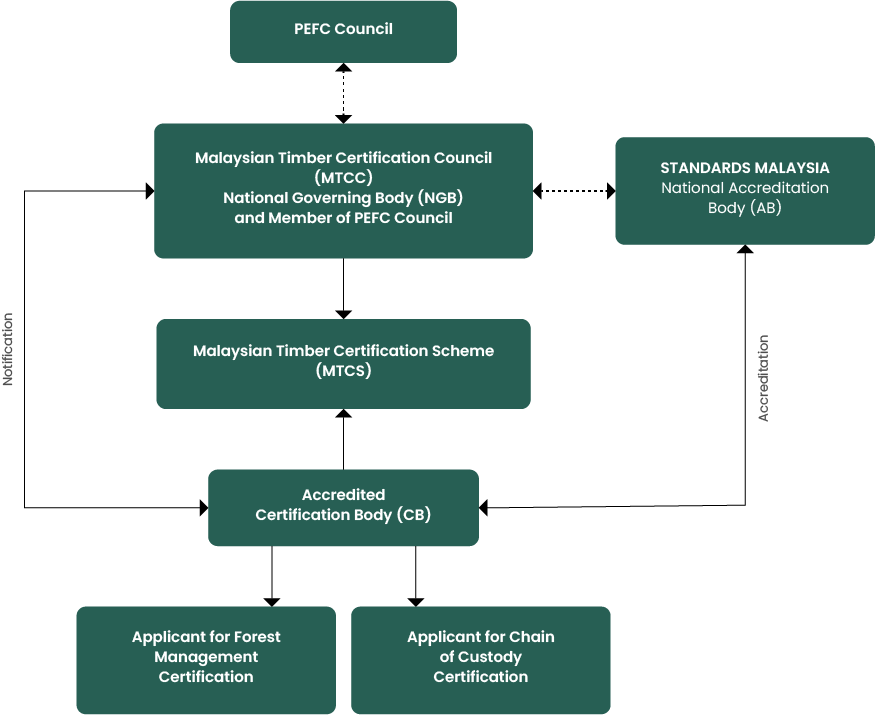
The MTCS works through a clear separation of roles. The body that owns the scheme, the body that grants accreditation, and the bodies that carry out certification are kept independent of one another. This separation is what allows certification under
the MTCS to remain impartial and credible.
- Our Institutional Framework
MTCC, scheme owner and administrator.
MTCC develops, governs and administers the MTCS and coordinates the multi-stakeholder process that sets its standards. It grants PEFC notification to accredited Certification Bodies and issues PEFC trademark licences to certificate holders. MTCC does not carry out audits or issue certificates itself; certificates are issued by the Certification Bodies.
Standards Malaysia, national accreditation body.
The Department of Standards Malaysia (Standards Malaysia) assesses and accredits the Certification Bodies that operate under the MTCS against the relevant international standards (ISO/IEC 17021-1 for forest management; ISO/IEC 17065 with PEFC ST 2003:2020 for chain of custody) and verifies that their auditors are competent to carry out forest management or chain of custody audits.
Certification Bodies, independent third parties.
Certification is carried out by accredited Certification Bodies (CBs). These are independent, third-party organisations that audit applicants against the certification standard, grant certification where the requirements are met, and carry out regular surveillance audits to verify continued compliance throughout the certification period. To safeguard impartiality, a CB cannot provide consultancy, manage the forests it assesses, or act as a decision-making body in standard setting, and it must be independent of the organisation it certifies.
Applicants.
Applicants are the organisations seeking certification. For forest management certification, these are the managers of forest management units and forest plantation management units. For chain of custody certification, these are the companies that manufacture, supply, export, import or further process timber products using certified material.
- Two Types of Certifications
Forest management certification
verifies that a forest is managed in line with the MTCS ST 1002:2021 – Malaysian Criteria and Indicators for Sustainable Forest Management (MC&I SFM), covering the economic, social and environmental
aspects of forest management.
Chain of custody certification
How
certification works
An organisation applies to an accredited Certification Body, which carries out an independent audit. The audit involves a review of documents, consultation with stakeholders where relevant, and a visit to the forest or site. To keep the decision separate from the audit, the certification decision is made by a representative of the Certification Body who did not take part
in the audit.
For forest management certification, a summary of the audit findings, including a map of the certified area, is made publicly available. Once certified, an organisation undergoes surveillance audits at intervals of no more than one year, with full
recertification every five years.
- How the standards are set
The standards used in the MTCS are developed through an open, multi-stakeholder process that is kept independent of certification and accreditation. They are reviewed periodically in the light of new scientific knowledge and practical
experience, at intervals not exceeding five years.
- Raising a complaint or dispute
MTCC has a formal procedure for handling complaints and disputes connected with its role in administering the scheme. Complaints about a certified organisation, a Certification Body or the accreditation body are handled through the
procedures of those respective bodies. See our complaints page for details on how to submit a complaint.
For the full details of how the MTCS operates, see MTCS 10/2020 – The Malaysian Timber Certification Scheme (MTCS) and Its
Implementation Arrangement.